This series of articles is designed to give you enough information to at least determine where I’m coming from, and what you might expect from my professional search engine optimisation services and/or my SEO seminar and workshop. For those who have certain skills (e.g. copywriting, marketing, web development) and/or relatively modest goals, they may be all you need to move forward on your own. If you quote (or benefit) from any of the following, I request only that you reward the content with a link. Cheers all.
I’m fortunate enough to have developed an interest in search engine optimisation as the main commercial interests were stepping in and their competing efforts to gain users – often funded by some quite ridiculous dotcom cash – greatly accelerated the evolution of search technology.
All of these search engine providers were very secretive about their methodology for reasons that should be obvious, but I was conducting live experiments throughout this period and was able to determine (for example) that Google ranked sites according to “one or more types of history data” long before any of their patent documents let this particular cat out of the bag.
But the main thing I took away from this unique experience was an understanding of the unchanging direction of this evolution; search engine providers strive to serve/gain users by determining and rewarding actual relevance.
[NOTE – Relevance is measured in degrees, and the two major aspects of relevance are the information itself (dealt with on this page) and where it is coming from (dealt with in Relevance #2 and Relevance #3).]
This may sound incredibly simple and obvious, but you’d be surprised.
The point at which I realised this was not all that different from the moment I realised that I had gone as far as I needed to in maths class. The teacher was trying to explain how one might calculate the trajectory and initial landing position of a projectile fired from one point towards another on an incline. As different influencing factors were taken into account, the diagram on the blackboard (yes, I am that old) grew more and more complicated. What was the mass of the projectile? What force was applied to it, and at what angle? What influence did the force of gravity play? How might we measure this while taking into account that the event was taking place in an incline? Did the projectile spin, and in what direction relevant to its trajectory? What was its shape and surface area? How did it react to atmospheric forces such as friction and wind? And so on and so forth until they completely lost me because I realised at that moment I already knew enough to throw, catch and/or kick a ball, and I was wasting a perfectly good summer’s day worrying about the detail.
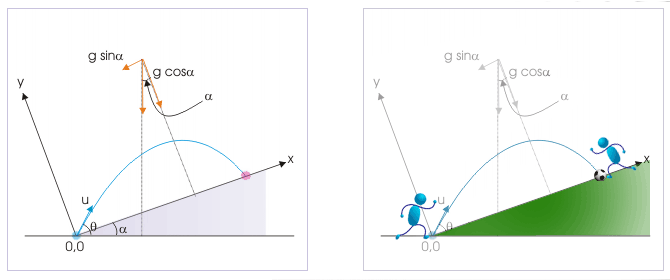
Source of modified original: Sunil Kumar Singh: Projectile motion on an incline
These days, before I make any major decision, I simply ask myself if it’s in keeping with the (so far unchanging) principle of genuine relevance. Most day-to-day decisions, however, require no internal dialogue and come as second nature… just as they do when I walk out the front door wearing trousers and not spitting on people.
To succeed in search engines, it is likely that all you need to get by is a basic understanding of the environment in which you wish to compete, perhaps with some expert help when times are tough or the stakes are high (for example; you may be completely innocent and know the difference between right and wrong, but only a fool would defend themselves in court on a murder charge). It is in this spirit that I offer the following range of specifics that are my no means linear or comprehensive, but should be enough to open your eyes to the wider truth of the matter (i.e. while it contains some ‘how to’ elements, it is less of a ‘how to’ guide, and more of an opportunity to familiarise yourself with the environment so you can get your balls out and get on with life):
META Tags and Relevance
Yep, straight in at the deep end. Don’t worry, I won’t hurt you. META Tags are like little index cards that summarise the contents of a site, category or page. Also a bit like the short blurb on the back of a DVD box, if you’re too young to know what an index card is. Once upon a time, these were needed because indexing robots (sent out by search engines to discover new information) did not have the time/capacity to read everything on every page, but as they did develop this ability, search engine providers soon learned that almost everyone who thought to include META Tags lied about the actual contents of their site/page (probably as much as you have on your CV in the past, for much the same reason). With some rare exceptions, these days I only ever include a ‘Description’ META Tag on the main page(s), or on pages (like this one) that take a while to get to the point and require an effective introduction or summary. Any ‘Keywords’ tags you see on this site are after-thoughts for my own reference or leftovers from a bygone era (I run a very messy lab). I do not use ‘Keywords’ tags any more, because search engines don’t take them seriously any more. Most don’t even look sideways at them. The point you should be taking away here is the value of genuine relevance and how search engines sniff out bullshit over time.
Page Titles and Relevance
A ‘title’ tag exists in every HTML page. The text in this tag – when people think to include it – is displayed in the top of your browser window (look up to the very top/left of your screen, and/or to the tab for this page in your browser; the title for this page is “Relevance #1 – SEO: Search Engine Optimisation”). This text is also displayed as the text in the link when it appears as a result in a search engine for any given search query. Page Titles are the only summary of/on your page with any real influence, and if the main components of your keyword strategy are not apparent in your Page Titles, you will have a serious shortfall in visible/perceived relevance… not only from the point of view of the search engine, but from the point of view of the end user. Because the Page Title is the text that will form the hyperlink potential visitors see, these people will judge you by this (very) short description when considering you as an option against those directly above you or below you in search results. So Page Titles not only need to contain the right keywords, they also need to be elegant and descriptive and contain a compelling call to action where possible. All this and you need to get your point across in under 70 characters (that’s half a tweet, folks) because that’s all most search engines display, and you don’t want to stray too far beyond this regardless of the remaining relevance factor because the more words you include, the more they dilute the effectiveness of your most important words.
Success Breeds Success: Being Relevant
Being first isn’t always best. For example, if you’re in the top 5, and you have the more compelling Page Title (and/or Description), you will earn more click-throughs than the listings around you, and this can even lead to further improvement in your placement over time. Search engines seek to reward actual relevance; see if you can guess what they do with the data that comes back to them showing which links get clicked the most for any given query.
A. A. Aardvark: Only Appearing Relevant
I have never called any company – locksmith, landscaper, limo hire or otherwise – that seeks to place itself first in the phone book or directory by naming itself “000000 AAAA1 Car Hire”. It comes across as cheap, and so does using meaningless strings of keywords in a clumsy attempt to appear relevant. Even the average consumer is aware of this game, which is why the following joke is so popular:
How many SEO copywriters does it take to change a lightbulb, light bulb, bulb, lamp, light, eco-bulb, bulbs, fluorescent tubes?
Scaling Relevance
OK, so now you know enough about Page Titles and their importance/role to understand this key example; what follows is a Page Title that is descriptive, contains a call to action, and also contains a combination of keywords that might be of importance to a site selling chocolate. A brand new site with no reputation to speak of has no chance of being the top search result for ‘chocolate’ immediately, but the site owner might hope to immediately/quickly be a high search result for a more unique (but still potentially lucrative) query such as ‘buy chocolate online uk’. If they work on the link popularity of their site over time, the likelihood of them performing for more lucrative queries increases, (important bit #1) they are enjoying increasingly lucrative rewards on their journey to this goal, and (important bit #2) they do not have to pay some joker money to come in and fiddle about with their keywords on a monthly basis because all of the relevant keywords are contained within a single, unchanging Page Title.
NomNom (UK) – Buy chocolate online
Contains:
– chocolate
– buy chocolate
– buy chocolate online
– chocolate uk
– buy chocolate uk
– buy chocolate online uk
Coordinating Relevance
Of course, the example above only takes into account a single page and Page Title, as it is designed mainly to help you appreciate the point (i.e. it is not a strategy in itself). What you need to do is scale your relevance on a site-wide basis, and it is here I hope you will understand how it is possible to generate a commanding search result for your entire product/service range without attempting to list every product/service on your front page, and how it is possible to have every Page Title on your site working towards your main keyword strategy without having the same damn Page Title on every single page. (I still see this on some sites. It makes me want to cry.) At the top are three Page Titles, one for the front page and one for each of the main categories, and under that is the keyword query pattern that should help you appreciate how scaling works on any scale:
NomNom (UK) – Buy chocolate online
NomNom (UK) – Buy dark chocolate online
NomNom (UK) – Buy milk chocolate online
chocolate
chocolate uk
buy chocolate
buy chocolate online
buy chocolate online uk
dark chocolate || milk chocolate
dark chocolate uk || milk chocolate uk
buy dark chocolate || buy milk chocolate
buy dark chocolate uk || buy milk chocolate uk
buy dark chocolate online || buy milk chocolate online
buy dark chocolate online uk || buy milk chocolate online uk
Generic Keyword Research & Relevance
A generic keyword is a keyword that might be used to describe your company or a company like yours… i.e. what potential customers might put into a search engine when they don’t know your brands name and/or are shopping around for alternatives. In the example above, it is not the brand name ‘NomNom’, but ‘chocolate’ (which is what they sell). In some cases, the choice of generic keyword(s) may not be as obvious as ‘supermarket’ is for Tesco or ‘real estate’ is for Foxtons; sometimes you may better hope to gain potential customers by performing for search queries that have to do with an associated matter, but the key to this is still aspiring to being relevant to the query. The best example I can think of here is a groundbreaking toddler’s gaming console that couldn’t take advantage of generic queries for their type of product because almost no-one knew that a product like this existed. However, they had paid licensing fees for a series of popular TV characters as part of their product development, and all that remained was to take these assets they were already permitted to use and create traffic-earning pages based on these characters. Parents searching for free/cheap activities for their children based on their favourite characters (such as free colouring-in images of Noddy or Thomas the Tank Engine) would in this way discover the website of a gaming console with at least one game likely to appeal to their child. We made the site relevant to their needs, and used the opportunity to show how the console was equally relevant. Anyone can research how often certain keywords are used in Google using the Adwords Keywords Tool, but this tool is useless without good marketing instincts and knowledge of your potential customer base. This is why any keyword research I do is conducted in conjunction with the client… and why I prefer to teach the client how to think/act at this level for themselves where possible.
Page Copy, Categories and Relevance
Search engines reward/favour text that is awarded higher status than other text; for example, if it is bold or classified as a header, or if it hyperlinks to further information. If you have a long-term keyword strategy and coordinate your content towards this strategy, all of the most important words are already going to be classified and arranged in this way, as they will be integral to the structure of your website, and it will show. The same goes for your cumulative relevance when any given category page (or even the main page) is balanced against your wider content (and, it must be noted, how people have reacted to it). The backwards way to do it is to have some bloke come in after the fact and fiddle with your existing unrepresentative arrangement so certain words only appear to be important. If you manage to ‘fool’ a search engine in this way, I congratulate you and wish you well… but I know it can’t last because evolution is working against you. Your relevance should flow from the centre, not be hammered onto the surface like cheap cladding.
Offsite Relevance
While clumsy attempts at attaching keywords to inbound links are largely discounted these days (Google is especially good at detecting automation, professional/commercial link networks and the sin of ‘keyword weighting’) it remains an integral part of their calculations to regard certain pages or websites to be more relevant for any given query if people from outside that website use the same or related keywords to describe it when linking to it. The more widespread and organic this activity is, the more you are rewarded. When I say ‘organic’, I mean spontaneous and natural… i.e. the result of your page actually earning a link because it was deemed to be worthy of a link by another web user. They themselves have their own relevance in the eyes of the search engines, and they can lend some of that relevance to you simply by respecting you enough to grace you with a hyperlink. By now you should understand that all this ‘reputation’ people speak of is made of the same stuff we’ve been talking about here; relevance… and if you want long term success this has to be as genuine as the relevance on your site.
(For more on this topic, and to better understand how relevance is everything, see Relevance #2 and Relevance #3.)
If you still feel that some or all of the above is beyond you, or way too much for some of your staff, I can come over to your place and explain it all using props. No, seriously.